Description
What is truth in Plato’s Apology of Socrates?
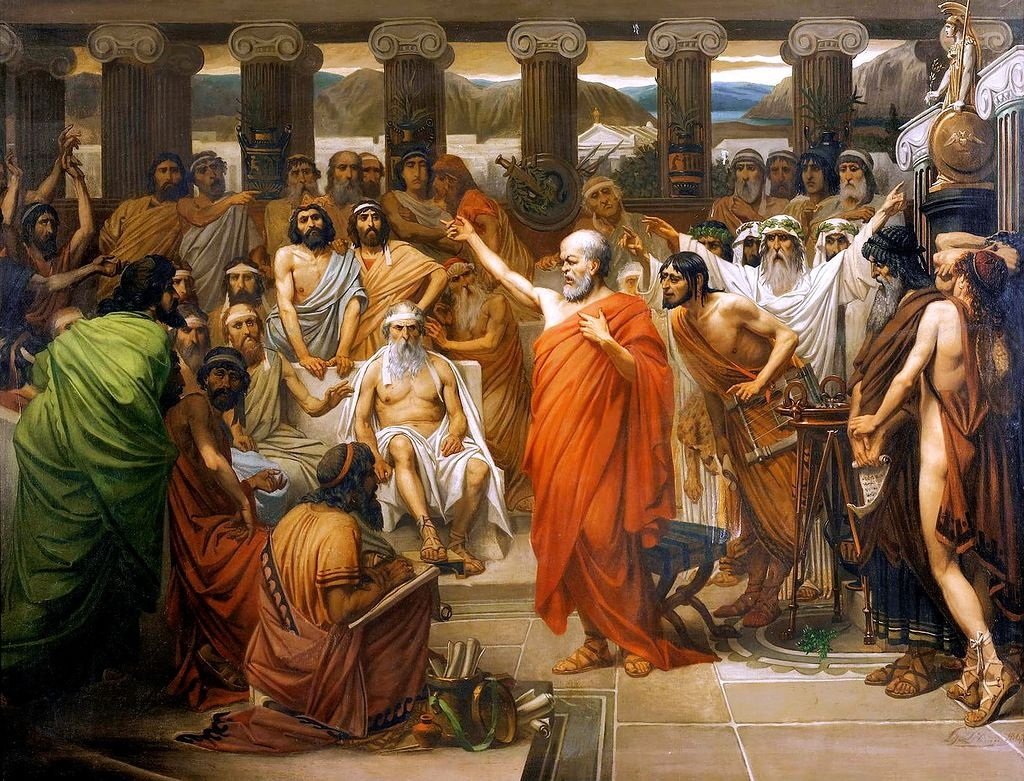
The discussion concerns the Apology, the speech Plato depicts Socrates delivering at his trial. Plato’s Socrates speaks of his previous dialogues with various Athenians after he turned his attention away from studying the natural world as a ‘scientist’. These dialogues invariably turn on the question of What is the good life? indeed, of What is the best possible life?
One great practical question that arises in reading the Apology is whether it is true that Socrates was guilty of the charges laid against him. Some of those who regard Socrates as a heroic figure believe he was not guilty of these charges, but others such as Hegel and Nietzsche argue that the situation is far more complicated.
Our facilitator, Chris Coney, will open the discussion by arguing that even though Socrates was not guilty of the charges, neither Socrates nor his accusers were always and consistently truthful. For Socrates this is perhaps where he is being ironic, where the irony is specific to the circumstances of each speech situation. If this is right, it means that Socrates is not always using speech in the same way. The Socratic ‘manner of speech’ is certainly peculiar in being habitually driven by the What is …? question. But, as much as his accusers, he uses various rhetorical techniques to promote his peculiar way of thinking and of living. So, where in all of this rhetoric can we possibly find Plato’s truth?
In preparation for the discussion please read the first few pages of The Apology (up to page 23b) in this preferred translation by Thomas West (PDF)
Attend in person 2.30 pm Saturday 5 December at the Kathleen Syme Centre 251 Faraday St, Carlton
Followed by Refreshments
